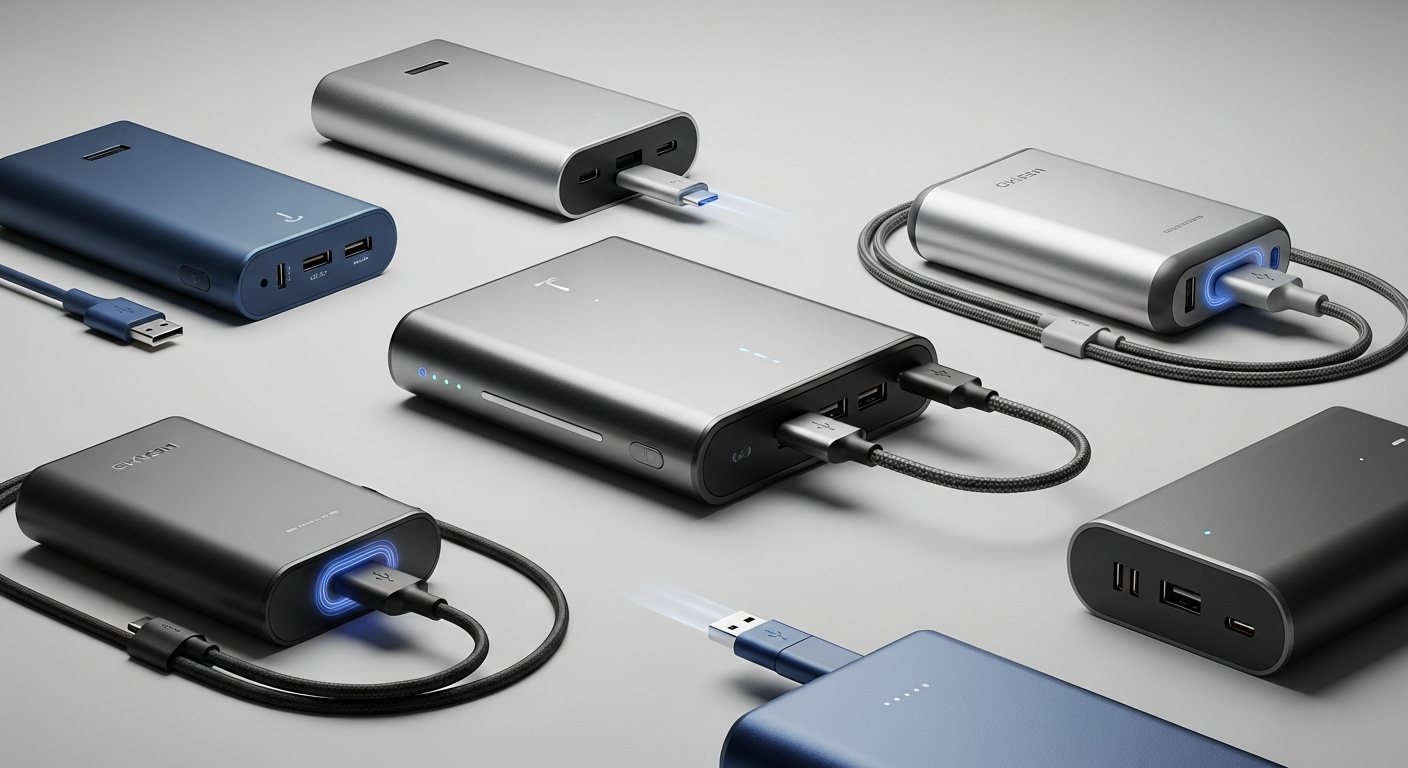
A fast charging portable charger only earns that label if it can push real wattage through the right protocol to your specific phone, not just print a big number on the box. In 2026, the market is flooded with power banks claiming “super fast” charging, but most buyers still end up with a device that trickles instead of races. This guide cuts through the wattage confusion so you can pick a charger that actually delivers.
We’ll break down what PD, GaN, and QC actually mean for your charging speed, then show you how to match a power bank to your phone. No jargon overload, just practical buying advice.
What Makes a Portable Charger Actually “Fast”?
Speed comes down to three things: wattage, protocol compatibility, and cable quality. A high wattage rating means nothing if your phone doesn’t support that protocol.
Most modern smartphones cap their charging speed regardless of what the power bank offers. An iPhone, for example, typically maxes out well below the 65W or 100W numbers you see advertised on chargers. That headroom exists for laptops and tablets, not your phone.
So the real question isn’t “how many watts,” it’s “does this charger’s protocol match my phone’s protocol.” That’s where PD, GaN, and QC come in.
PD, GaN, and QC Explained Simply
These three terms cause most of the confusion when shopping for a fast charging portable charger. Here’s the short version:
- PD (Power Delivery): The universal fast-charging standard used by iPhones, most Android phones, tablets, and laptops. If you want one protocol that works broadly, PD is it.
- QC (Quick Charge): Qualcomm’s proprietary standard, common on older and mid-range Android devices. Many newer phones have shifted primarily to PD, but QC support still matters for compatibility.
- GaN (Gallium Nitride): Not a charging protocol at all. GaN is a chip material that lets manufacturers build smaller, cooler, more efficient chargers. A GaN charger can support PD or QC, but GaN itself doesn’t determine charging speed.
Understanding this distinction stops you from paying extra for a “GaN fast charging portable charger” that doesn’t actually support the protocol your phone needs.
How to Match a Charger to Your Phone
Before buying, check your phone’s maximum supported charging wattage and protocol. This information is usually in the manufacturer’s spec sheet or quick-start guide.
Then, look for a power bank that meets or slightly exceeds that number. Buying extra wattage beyond your phone’s limit doesn’t hurt, but it also won’t speed up your charge.
Here’s a simple checklist for shopping smart:
- Confirm your phone’s max supported wattage and protocol (PD, QC, or proprietary).
- Choose a power bank that explicitly lists that same protocol.
- Check the included cable supports the full wattage; a weak cable bottlenecks everything.
- Look at battery capacity in mAh versus your phone’s battery size for a realistic number of charges.
- Consider size and weight if you travel often or carry the charger daily.
Capacity vs. Speed: Why Bigger Isn’t Always Better
A larger battery capacity means more total charges, not faster charges. Don’t confuse the two when shopping.
A compact 10,000mAh fast charging portable charger with the right PD wattage can refill your phone faster than a bulky 20,000mAh bank running an outdated protocol. If speed is your priority, protocol support matters more than raw capacity.
That said, if you’re often away from outlets for extended trips, a higher-capacity option makes sense. Just don’t sacrifice protocol support to get there.
Real-World Factors That Slow Down Charging
Even the best charger underperforms if other conditions work against it. Keep these in mind:
- Temperature: Charging slows automatically in very hot or cold environments to protect the battery.
- Case interference: Thick phone cases can trap heat and trigger slower charging speeds.
- Cable quality: A cheap or damaged cable limits current flow no matter how powerful the charger is.
- Simultaneous use: Charging while actively using your phone for gaming or video slows the overall rate.
Addressing these small details often makes a bigger difference than upgrading to a higher-watt charger.
Portable Chargers vs. Other Backup Power Options
A power bank isn’t the only way to keep your phone alive on the go. If you want charging built directly into your phone’s case, check our guide to the best battery cases of 2026 for a more integrated solution.
For bigger power needs, like camping trips or multi-device charging, it helps to understand the difference between a standard power bank and a larger station. Our comparison of a portable power station versus a power bank breaks down which one fits your lifestyle.
And if you’re building out a full travel tech kit, don’t forget accessories like item trackers to keep tabs on your gear or a portable monitor for working on the go. A well-rounded setup makes travel and remote work far less stressful.
Tips for Getting the Most Out of Your Charger
A few simple habits extend both charging speed and battery lifespan over time.
- Charge your power bank fully before trips, since a partially charged bank charges your phone slower overall.
- Avoid extreme temperatures during use and storage.
- Use the cable that came with the charger whenever possible.
- Remove thick cases during charging if your phone runs warm.
These small adjustments help any fast charging portable charger perform closer to its advertised potential.
Frequently Asked Questions
What wattage do I need for a fast charging portable charger?
Most phones charge fastest between 20W and 45W. Check your phone’s specifications first, then choose a charger that matches or slightly exceeds that number rather than assuming higher wattage always means faster charging.
Does GaN technology make a charger charge faster?
Not directly. GaN is a chip material that allows smaller, more efficient chargers, but the actual charging speed depends on the supported protocol, like PD or QC, not the presence of GaN itself.
Can I use a fast charging portable charger with any phone?
Yes, but speed depends on protocol compatibility. Most chargers work with any USB-C or Lightning device, but they’ll only charge at the fastest available speed if your phone supports the same protocol the charger uses.
Choosing the right fast charging portable charger comes down to matching protocol and wattage to your specific phone, not chasing the biggest number on the box. Once you understand PD, GaN, and QC, shopping becomes far less overwhelming. If your tech setup extends beyond charging, our guides on mini projectors for movie nights anywhere and VR and AR headsets can help round out your gadget collection.
A sleek compact GaN fast charging portable charger and power bank with USB-C cables plugged into a smartphone, placed on a modern wooden desk near a laptop
A fast charging portable charger with USB-C cable charging a smartphone on a desk
[“portable chargers”, “fast charging”, “power banks”, “USB-C PD”, “GaN chargers”, “tech gadgets 2026”]