The portable power station vs power bank debate comes down to one simple question: do you need to charge a phone, or do you need to run a household appliance? If it’s the former, a power bank wins on convenience. If it’s the latter, a power station is the only real option.
Both devices store electricity for use away from a wall outlet, but they’re built for very different jobs. Understanding the portable power station vs power bank divide up front means you won’t end up lugging around excess weight or running out of juice when you need it most.
In this guide, we’ll break down the real differences in the portable power station vs power bank comparison, match each device to common scenarios like travel, power outages, and camping, and help you decide which one — or whether both — belong in your gear bag.
Portable Power Station vs Power Bank: The Core Differences
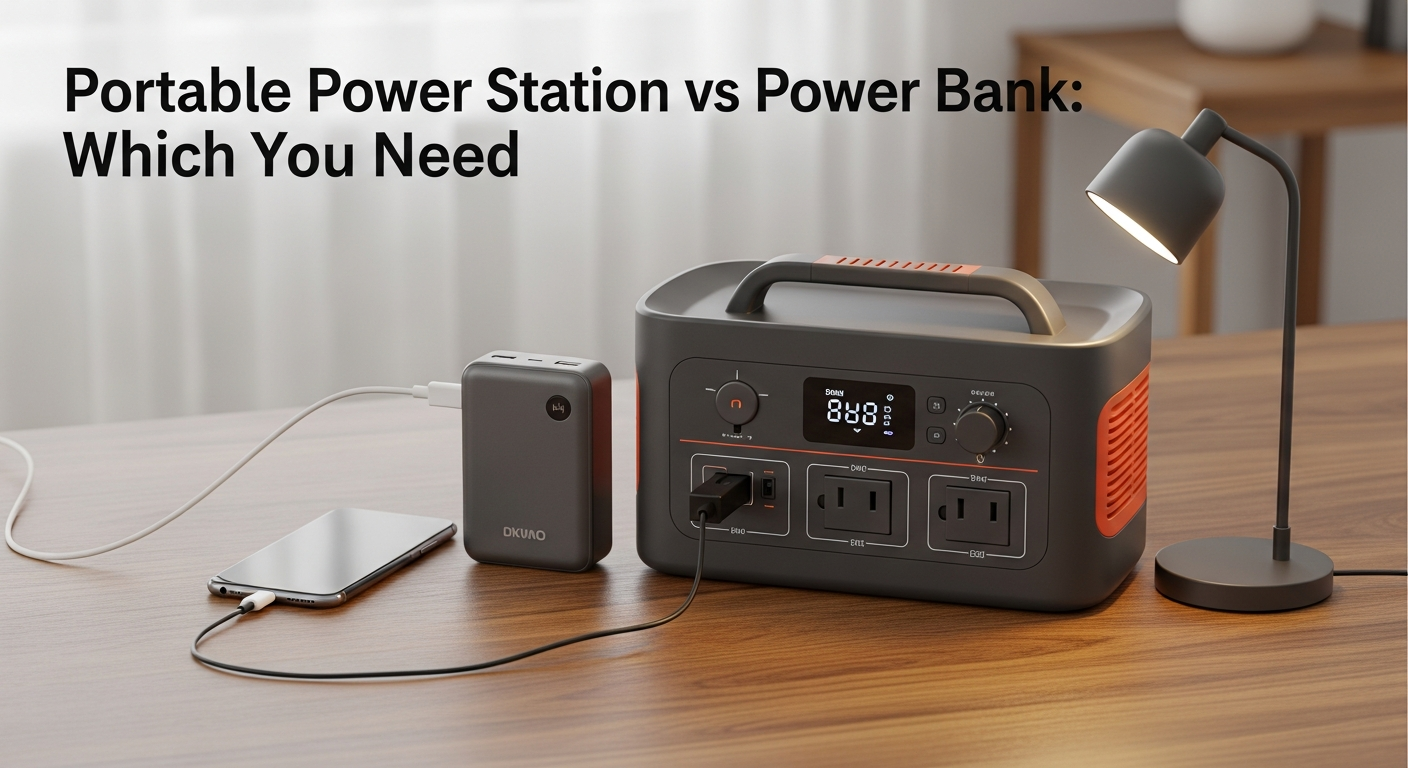
A power bank is a small battery pack designed to recharge phones, earbuds, and other USB-powered gadgets. It typically fits in a pocket or small bag and weighs well under a pound.
A portable power station is a much larger battery system with AC outlets, higher capacity, and the ability to run appliances like mini-fridges, CPAP machines, or laptops. Most models weigh several pounds and are sized more like a small cooler or toaster.
Here’s a quick side-by-side summary of the portable power station vs power bank comparison:
- Power bank: Compact, USB-only output, charges phones and small gadgets, low capacity, cheap and lightweight.
- Power station: Bulky, includes AC outlets and sometimes solar input, high capacity, can run larger devices, higher price point.
- Charging speed: Power banks recharge in 1-3 hours; power stations can take several hours unless using fast-charge or solar options.
- Portability: Power banks fit in a pocket; power stations need a bag, backpack, or vehicle trunk.
When a Power Bank Makes More Sense
Power banks are the practical choice for everyday mobility. If your main concern is keeping your phone alive during a commute, flight, or festival, a power bank does the job without adding bulk.
They’re also ideal companions for gadgets that already have small batteries, such as wireless earbuds or a pocket-sized AI companion device. Since these gadgets sip power rather than gulp it, a modest power bank can top them off multiple times.
Consider a power bank if you:
- Travel light and prioritize pocket-friendly gear.
- Only need to charge phones, tablets, or small accessories.
- Want an affordable backup for daily use, not emergencies.
- Fly often, since most power banks meet airline carry-on battery limits.
When a Portable Power Station Is the Better Investment
Power stations shine when the stakes are higher than a dead phone. During a blackout, they can keep a router, fan, or medical device running for hours. That reliability matters more than convenience in an emergency, which is where the portable power station vs power bank decision really tips in favor of the larger unit.
They’re also popular with campers and van-lifers who need to power lights, coolers, or even small kitchen appliances off the grid. Many models pair with solar panels, letting you recharge during the day and use stored power at night.
If you work remotely from unpredictable locations, a power station can also keep a laptop and monitor running — useful alongside accessories like a reliable USB-C hub for connecting multiple devices when you’re away from a proper desk setup.
Good Reasons to Choose a Power Station
- You experience frequent power outages and need backup for essential devices.
- You camp, road-trip, or work outdoors and need to run more than a phone.
- You want solar-charging capability for extended off-grid trips.
- You need to power multiple devices simultaneously, not just one gadget.
Matching the Right Device to Real-Life Scenarios
Choosing between the two isn’t about which is “better” overall — it’s about matching capacity to your actual needs. Let’s look at three common situations where the portable power station vs power bank choice plays out differently.
Travel and Commuting
For most travelers, a power bank is the smarter pick. It’s light, TSA-friendly, and enough to keep a phone or a portable VR headset for entertainment on long flights charged during transit.
Home Power Outages
Here, a power station is worth the investment. It can keep your smart doorbell running during a power outage and even power a small heater temporarily, unlike a phone-sized battery pack.
Camping and Outdoor Adventures
This scenario often calls for both. A power bank handles phones and headlamps, while a power station runs a cooler, string lights, or charges everyone’s devices overnight.
Capacity, Weight, and Price: What to Expect
Capacity is usually measured in watt-hours (Wh). Power banks generally range from around 5,000 to 30,000 mAh, translating to roughly 20-100 Wh — enough for several phone charges.
Power stations typically start around 200 Wh and can exceed 2,000 Wh for larger models. Naturally, weight and price scale up with capacity, so buyers should match the size to their actual power needs rather than buying the biggest unit available.
As a rule of thumb, ask yourself what you’re powering, for how long, and how far you’ll need to carry the device. That answer usually settles the portable power station vs power bank question in your specific case.
Final Verdict: Which One Should You Buy?
If your power needs are limited to phones, earbuds, or small gadgets, a power bank is affordable, portable, and sufficient. If you need backup during outages or want to run appliances while camping, a portable power station is the more capable — if bulkier — choice.
Many households benefit from owning both: a power bank for daily convenience and a power station for emergencies or outdoor trips. When weighing portable power station vs power bank options, assess your typical use case first, then choose accordingly rather than defaulting to the most powerful — or most portable — option.
Frequently Asked Questions
Can a power bank replace a portable power station?
No. Power banks lack AC outlets and the capacity to run appliances, so they can’t fully replace a power station for outages or camping needs beyond charging small devices.
Do portable power stations work during a home power outage?
Yes, many portable power stations can run essential electronics, medical devices, and small appliances for hours during an outage, depending on their capacity.
Is it worth owning both a power bank and a power station?
For many users, yes. In the portable power station vs power bank comparison, a power bank covers daily portability needs, while a power station handles emergencies, travel, and outdoor power demands that exceed a power bank’s limits.