This portable monitor buying guide exists because most spec sheets are more confusing than helpful. Brands love to highlight numbers that sound impressive but rarely matter for real-world use. Let’s cut through the noise and focus on what actually affects your daily experience.
A portable monitor should be simple: plug it in, and get a second screen wherever you work. But with dozens of models claiming “4K,” “144Hz,” or “ultra-bright,” it’s easy to overpay for features you’ll never use. This portable monitor buying guide walks you through the specs worth caring about, and the ones you can safely ignore.
Why a Portable Monitor Buying Guide Matters More Than Spec Sheets
Marketing copy is designed to grab attention, not to match your workflow. A gamer, a remote worker, and a video editor all need very different things from a second screen. That’s exactly why a solid portable monitor buying guide focuses on use cases instead of raw numbers.
Instead of chasing the highest number on the box, think about how and where you’ll use the monitor. That single question filters out most of the confusion instantly.
Screen Resolution: Bigger Numbers Aren’t Always Better
Full HD (1920×1080) is plenty for most people doing email, spreadsheets, or browsing. It’s also easier on battery life and connection bandwidth.
4K resolution looks sharper, especially for photo or video editing. But it demands more power from your laptop and often shortens battery runtime. If you’re already dealing with a laptop that struggles to hold a charge, check out our guide on fixes for a laptop battery draining fast before adding a power-hungry external display to the mix.
Brightness: Where Marketing Fluff Creeps In
Brightness is measured in nits, and higher isn’t automatically better. Most portable monitors sit between 250 and 400 nits, which is fine for indoor use.
If you plan to work outdoors or near bright windows, look for something closer to 400 nits or higher. Otherwise, don’t pay extra for brightness you won’t notice in a typical office or bedroom.
Refresh Rate: Does It Actually Matter for You?
Refresh rate gets a lot of attention in gaming circles, and for good reason. A 120Hz or 144Hz panel makes fast motion look smoother, which matters for competitive gaming.
But for productivity, writing, or video calls, a standard 60Hz refresh rate is completely sufficient. Paying more for a high refresh rate you won’t use is a common way buyers overspend, and it’s one of the first things any good portable monitor buying guide should flag.
- 60Hz: Best for office work, browsing, and general productivity.
- 90-120Hz: Noticeable smoothness for casual gaming or scrolling.
- 144Hz+: Worth it only for competitive or fast-paced gaming.
Power Draw and Connectivity: The Specs People Overlook
Most portable monitors run off USB-C, drawing power directly from your laptop or a separate adapter. This is where things can go wrong if you don’t check compatibility first.
Some laptops don’t supply enough power through a single USB-C port to run both the laptop and the monitor. In that case, you’ll need a separate power source or a higher-wattage charger. Our USB-C charger wattage guide explains exactly how many watts different devices need, which helps you avoid a monitor that won’t power on reliably.
Ports and Cables: The Detail That Ruins Setups
Not every “USB-C” port supports video output. Some are power-only, and that detail is often buried in fine print.
Before buying, confirm your laptop’s USB-C port supports DisplayPort Alt Mode or Thunderbolt. Also check whether the monitor includes the cables you need, since many budget models skip this and expect you to buy separately.
Build Quality, Stands, and Portability
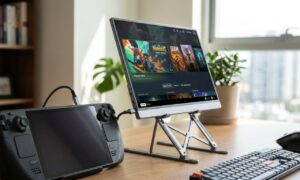
A portable monitor is only as useful as its stand. Some fold into a case, others use a magnetic cover as a kickstand. Test how sturdy the stand feels before committing, especially if you’ll use it on a train, in a cafe, or at a shared desk.
Weight matters too. Anything under two pounds travels well, but panel size and battery (if built-in) can add bulk quickly.
Should You Consider a Refurbished Portable Monitor?
Refurbished monitors can offer serious savings without much downside, as long as you buy from a reputable seller. Screens are simple electronics with few moving parts, which makes them a relatively safe refurbished purchase.
If you’re unsure how to spot a trustworthy refurbished listing, our guide on whether refurbished electronics are worth it walks through the red flags and safety checks to use before buying.
Storage and Multi-Monitor Workflow Considerations
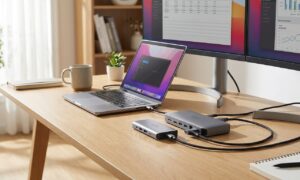
If you’re adding a portable monitor to boost productivity, it’s worth thinking about your whole setup, not just the screen. Faster storage can reduce lag when switching between apps across two displays.
If your laptop still runs on a traditional hard drive, upgrading could make a bigger difference than any monitor spec. Our comparison of SSD vs HDD storage in 2026 breaks down which option fits different budgets and use cases.
A stable internet connection also matters if you’re using the monitor for video calls or cloud-based work. Weak WiFi in a home office can undercut even the best display setup. If you notice dead zones, our breakdown of mesh WiFi versus range extenders can help you fix connectivity gaps.
Final Checklist Before You Buy
Use this quick checklist from our portable monitor buying guide to sanity-check any model before adding it to your cart:
- Confirm resolution matches your actual use case, not just the highest available number.
- Check brightness only if you’ll use the monitor outdoors or in strong light.
- Skip high refresh rates unless you game competitively.
- Verify your laptop’s USB-C port supports video, not just charging.
- Test the stand or kickstand quality if possible, especially for travel use.
Frequently Asked Questions
What is the most important spec in a portable monitor buying guide?
Connectivity is usually the most important factor. A monitor with perfect brightness and resolution is useless if your laptop’s port can’t send a video signal to it.
Do I need a 4K portable monitor?
Only if you do detailed photo or video editing. For most productivity tasks, a Full HD panel looks sharp enough and uses less power.
Can a portable monitor drain my laptop battery quickly?
Yes, since most portable monitors pull power through USB-C. If battery life is already a concern, pair the monitor with a laptop that has strong battery health or use a separate power source.
How is this portable monitor buying guide different from a spec sheet?
Instead of listing every possible number, this portable monitor buying guide explains which specs actually change your daily experience and which ones are just marketing filler.