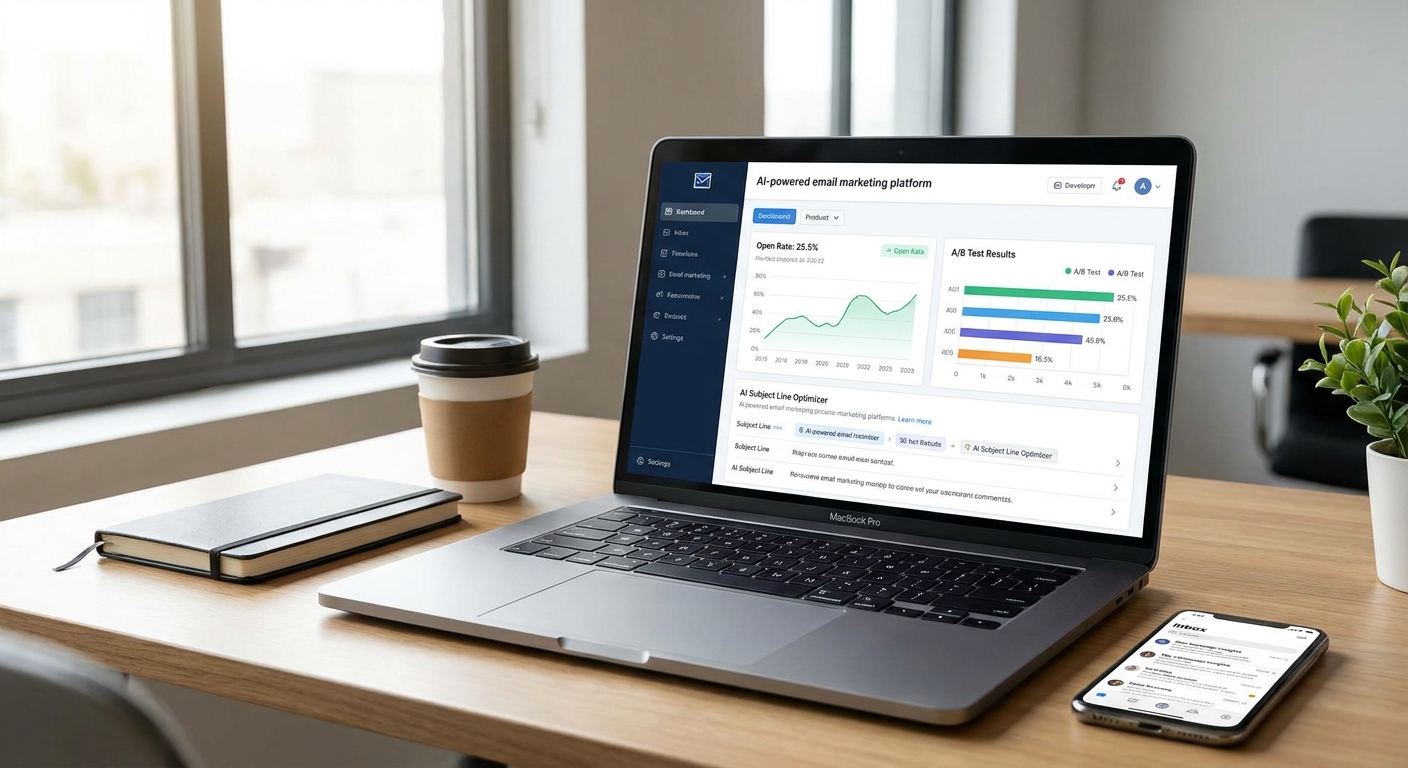
AI email marketing tools promise bigger opens and better automation, but most buying guides just repeat vendor claims instead of testing them. We ran side-by-side sends across several leading platforms to see which ones actually move the needle on deliverability, subject-line performance, and workflow quality. Here’s what held up under real conditions, and which tools fell short of their marketing.
How We Tested These AI Email Marketing Tools
We sent identical campaigns from matched lists through five platforms over a four-week window. Each list was split into control groups using human-written subject lines and test groups using AI-generated alternatives.
We tracked three things: inbox placement rate, open-rate lift versus the control, and how much manual cleanup the automation needed afterward. We also noted how long each tool took to set up a working automation sequence.
- Deliverability: did emails land in the primary inbox or get filtered to promotions and spam?
- Open-rate lift: how much did AI subject lines and send-time optimization improve opens versus a control?
- Automation quality: could the tool build usable workflows without heavy manual editing?
Which AI Email Marketing Tools Actually Boosted Opens
Not every platform delivered a measurable lift. Here’s a breakdown of what we found across the strongest performers in our test group.
Strong Deliverability, Modest Open Lift
Two of the platforms we tested had excellent inbox placement, often above 95 percent, but their AI subject-line suggestions only produced small gains over our human-written control. The automation builders in this tier were polished and required little manual fixing.
These tools suit marketers who already write decent subject lines and want reliable sending infrastructure more than aggressive AI rewriting.
Biggest Open-Rate Lift, But Inconsistent Sends
One platform produced the largest open-rate lift in our test, driven by genuinely sharper subject-line variants and smarter send-time prediction per contact. However, its deliverability was less consistent, with occasional dips into spam folders during high-volume sends.
If your list is smaller and you can monitor deliverability closely, this tradeoff may be worth it. For large lists, the risk is harder to justify.
Best Balance of Automation and Accuracy
The most balanced performer combined solid inbox placement with a measurable, if moderate, open-rate lift. Its automation builder also required the least manual rework, which matters if you’re running multiple campaigns without a dedicated email team.
This middle-ground option is often the safer commercial pick, especially for small businesses testing AI email marketing tools for the first time.
Features That Actually Matter in AI Email Marketing Tools
Marketing pages tend to emphasize flashy AI features that don’t always translate into results. Based on our testing, these are the capabilities worth prioritizing:
- Send-time optimization per contact, not just a single global best time
- Subject-line testing with real statistical significance, not just a single AI suggestion
- Deliverability monitoring built into the dashboard, so issues surface before a full send
- Workflow automation that adapts based on subscriber behavior, not just fixed time delays
- List hygiene tools that automatically flag inactive or risky addresses
Platforms that bundle these features tend to outperform ones that only offer AI-generated copywriting on top of a standard email builder.
Common Mistakes When Choosing an AI Email Platform
Many teams pick a tool based on demo screenshots rather than real performance. A few recurring issues showed up during our testing process.
First, some platforms over-rely on AI subject lines that sound clever but trigger spam filters due to excessive punctuation or urgency language. Second, automation builders that look simple in a demo often require significant manual tweaking once you add branching logic. Third, deliverability claims rarely account for list age or sender reputation, both of which heavily influence results.
Before committing, request a trial period long enough to run at least two real campaigns. A single send rarely reveals consistency issues.
Who Should Use AI Email Marketing Tools
These tools make the most sense for teams sending regular campaigns, at least weekly, where small open-rate gains compound over time. Occasional senders may not see enough volume to justify the cost difference between AI-powered and standard platforms.
Marketers juggling multiple projects may also find value in pairing email automation with other AI tools. For example, teams managing complex schedules often use AI scheduling assistants to plan send times around other commitments, or AI job search tools if they’re building recruiting-related email sequences. If your organization also handles client-facing questions, it’s worth comparing AI legal chatbots for accuracy standards similar to what we applied here.
Final Verdict
The best AI email marketing tools in 2026 aren’t necessarily the ones with the boldest claims. Based on our side-by-side sends, the platforms that balanced strong deliverability with a real, measurable open-rate lift performed best overall. Prioritize tools with transparent testing features and solid list hygiene over flashy AI copy generators alone.
Run your own short trial before committing to annual pricing. Email performance varies by industry and list quality, so results can shift even between similar-sized senders.
Frequently Asked Questions
Do AI email marketing tools really improve open rates?
Some do, but the lift varies widely by platform and list quality. In our tests, the strongest tools produced a measurable improvement over human-written subject lines, while others offered only marginal gains.
How much does deliverability matter compared to AI features?
Deliverability matters more. A clever subject line is useless if the email lands in spam. Always check a platform’s inbox placement track record before focusing on its AI copywriting features.
Are AI email marketing tools worth it for small businesses?
Yes, especially for businesses sending weekly or more frequent campaigns. The automation and testing features typically save time even if the open-rate lift is modest.